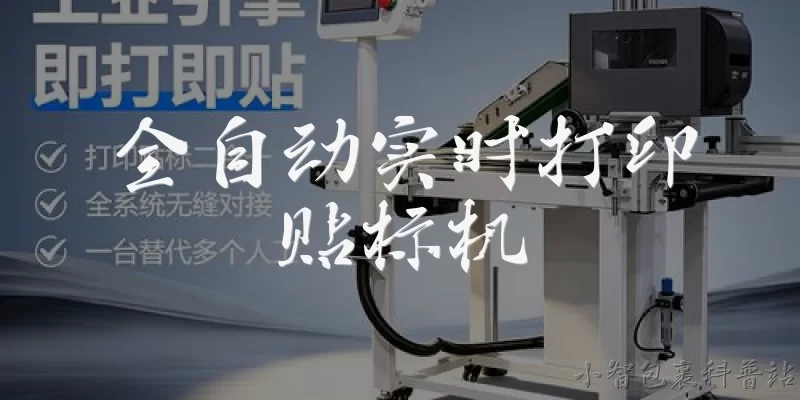
Fully automatic real-time print and apply labeling machine:What is a fully automatic real-time print and apply labeling machine and how does it work?
Q: What is a fully automatic real-time print and apply labeling machine and how does it work?
A: A fully automatic real-time print and apply labeling machine is an integrated system that prints label content on demand and immediately applies the printed label to a product, carton, or package moving along a production or packaging line. Unlike pre-printed label solutions, these machines generate each label at the moment it is needed, so variable data such as barcodes, serial numbers, batch codes, dates, weights, or customer-specific information stays accurate and current. The typical workflow begins when a product triggers a sensor or receives data from a host system such as an ERP, WMS, or MES. The machine's print engine then produces the label, and an applicator, whether a tamp-blow, air-jet, swing-arm, or robotic arm, transfers the label to the target surface at the correct position. Because the process is fully automatic, it eliminates manual label handling, reduces human error, and supports high-speed lines with consistent placement accuracy. Real-time operation ensures that every label reflects the latest production data, which is essential for traceability, regulatory compliance, and efficient logistics.
Q: What are the main benefits of using a fully automatic real-time print and apply labeling machine in production lines?
A: The primary benefits center on speed, accuracy, and operational efficiency. Because labels are printed and applied automatically in real time, manufacturers and logistics operators can eliminate the labor costs and errors associated with manual labeling while keeping pace with high-throughput lines. Real-time data integration means every label carries correct variable information, such as lot numbers, expiration dates, barcodes, and serialized codes, which supports product traceability and helps meet regulatory requirements in industries like food, pharmaceuticals, and electronics. These machines also reduce label waste because labels are only printed when needed rather than pre-printed in bulk and discarded when data changes. Consistent mechanical application improves placement accuracy and adhesion quality, reducing rework and customer complaints. In addition, automatic print and apply systems integrate with existing ERP, WMS, and MES platforms, enabling end-to-end visibility and faster changeovers between product runs. For businesses scaling operations or pursuing automation, these machines lower long-term operating costs, improve line uptime, and provide a reliable foundation for serialization, e-commerce fulfillment, and just-in-time manufacturing.
Q: How do you choose the right fully automatic real-time print and apply labeling machine for your application?
A: Selecting the right machine starts with clearly defining your application requirements. Consider the product or package type, surface material, label size, and required placement position, since these factors determine whether a tamp-blow, air-jet, swing-arm, or robotic applicator is most suitable. Evaluate line speed and throughput to ensure the print engine and applicator can keep up without becoming a bottleneck. Print resolution and technology, such as thermal transfer or direct thermal, should match barcode scanning and durability needs in your environment. Check integration capabilities, including standard protocols like Ethernet/IP, PROFINET, or serial interfaces, and compatibility with your ERP, WMS, or MES for real-time data flow. Also assess environmental conditions such as dust, moisture, and temperature that may affect performance. Consider ease of use, label and ribbon loading, remote diagnostics, and vendor support for maintenance and spare parts. Finally, request a demo or trial on your actual products and calculate total cost of ownership, including consumables and service. Matching the machine to your specific operational and data requirements ensures reliable, long-term labeling performance.
Words of experience
Common scenarios of "Fully automatic real-time print and apply labeling machine"
【Sales Engineer】 Good morning! Thanks for taking the time to meet. I understand your packaging line is looking to upgrade its labeling process—can you tell me a bit about your current setup?
【Production Manager】 Morning. Right now we're using a semi-automatic system—an operator has to feed the labels and apply them by hand or with a handheld applicator. It's slow and error-prone, especially on high-speed lines.
【Sales Engineer】 That's a common pain point. Our fully automatic real-time print and apply labeling machine eliminates manual feeding entirely—it prints the label on demand and applies it in one continuous flow. What's your typical line speed, in units per minute?
【Production Manager】 We run about 60 to 80 cartons per minute during peak shifts. Can your system keep up with that?
【Sales Engineer】 Absolutely. Our standard model handles up to 120 packs per minute, and we have a high-speed variant that goes up to 200. The real-time printing means there's no pre-printed label inventory to manage—each label is generated the moment the product reaches the applicator.
【Production Manager】 Real-time printing sounds good, but what about print quality and barcode readability? We deal with GS1 barcodes and QR codes for traceability.
【Sales Engineer】 Our system uses a 300 dpi thermal transfer print engine, and it's validated for GS1-128, DataMatrix, and QR codes. We can run a verification scanner after application that rejects any unreadable label—so nothing leaves the line with a bad barcode.
【Production Manager】 That verification feature is interesting. How does the rejection work—does it stop the line or divert the product?
【Sales Engineer】 It's configurable. You can set it to trigger an alarm, divert the product to a reject lane, or stop the conveyor. Most of our customers use the divert option so production keeps flowing while bad units are pulled aside.
【Production Manager】 And how does the system know when a product is in position? We have mixed product sizes on the same line.
【Sales Engineer】 We use a combination of photoelectric sensors and an encoder that tracks conveyor position. The applicator arm synchronizes with the product's leading edge, so it works whether you're labeling a small box or a large carton—no manual adjustment needed between product changes.
【Production Manager】 What about changeover time between different label formats? Our current process takes about 20 minutes to swap rolls and reconfigure.
【Sales Engineer】 With our system, label roll changes take under two minutes—it's a drop-in spindle design. Format changes are done through the HMI touchscreen, where you select the product recipe and the print template loads automatically. No mechanical adjustments.
【Production Manager】 That's a big improvement. What kind of maintenance does it require? We don't have a dedicated technician on every shift.
【Sales Engineer】 Maintenance is minimal—mostly periodic printhead cleaning and ribbon replacement. The HMI provides predictive maintenance alerts, like low ribbon or printhead wear, so your operators know in advance. We also offer remote diagnostics so our support team can troubleshoot without a site visit.
【Production Manager】 Remote diagnostics would be helpful. What about integration with our existing MES and ERP systems?
【Sales Engineer】 The machine supports Ethernet/IP, Profinet, and OPC-UA, so it integrates directly with your MES. You can push label data from the ERP—batch numbers, expiration dates, serial numbers—and the system prints them in real time. It also logs every print job for audit trails.
【Production Manager】 Audit trails are important for our compliance. What's the lead time and installation process like?
【Sales Engineer】 Standard lead time is 8 to 10 weeks. Installation typically takes two days, including commissioning and operator training. We also provide a one-week on-site support period after go-live to make sure everything runs smoothly.
【Production Manager】 Sounds reasonable. Can you send me a detailed proposal with pricing for both the standard and high-speed models, plus the verification scanner option?
【Sales Engineer】 Of course. I'll have the proposal to you by end of week. I'd also like to invite you to our demo facility so you can see the system running with your actual product samples—would next Tuesday work?
【Production Manager】 Next Tuesday works. I'll bring a few sample cartons and our label specifications. Thanks for the thorough overview—this looks like a strong fit for our line.